Formula
C₁₀H₁₆

Live Menu Intelligence Across Florida Dispensaries
Terpene Atlas · Monoterpene
/OH-sih-meen/ · β-Ocimene (cis and trans)
The sweet, green, open-chain monoterpene plants puff out as an airborne signal · popularly ‘uplifting,’ though it has no established direct effect on the human brain.
Meet the molecule
A family of acyclic isomers · cis- and trans-β-ocimene smell similar but behave differently on a gas chromatograph, so labs may split or merge them.
Aroma spectrum
Relative prominence is illustrative, not a measured profile. Aroma is never produced by one molecule alone.
Physical identity
This describes the isolated chemical. It does not predict whether flower will be dense, sticky, purple, or frosty.
 The resin, up close
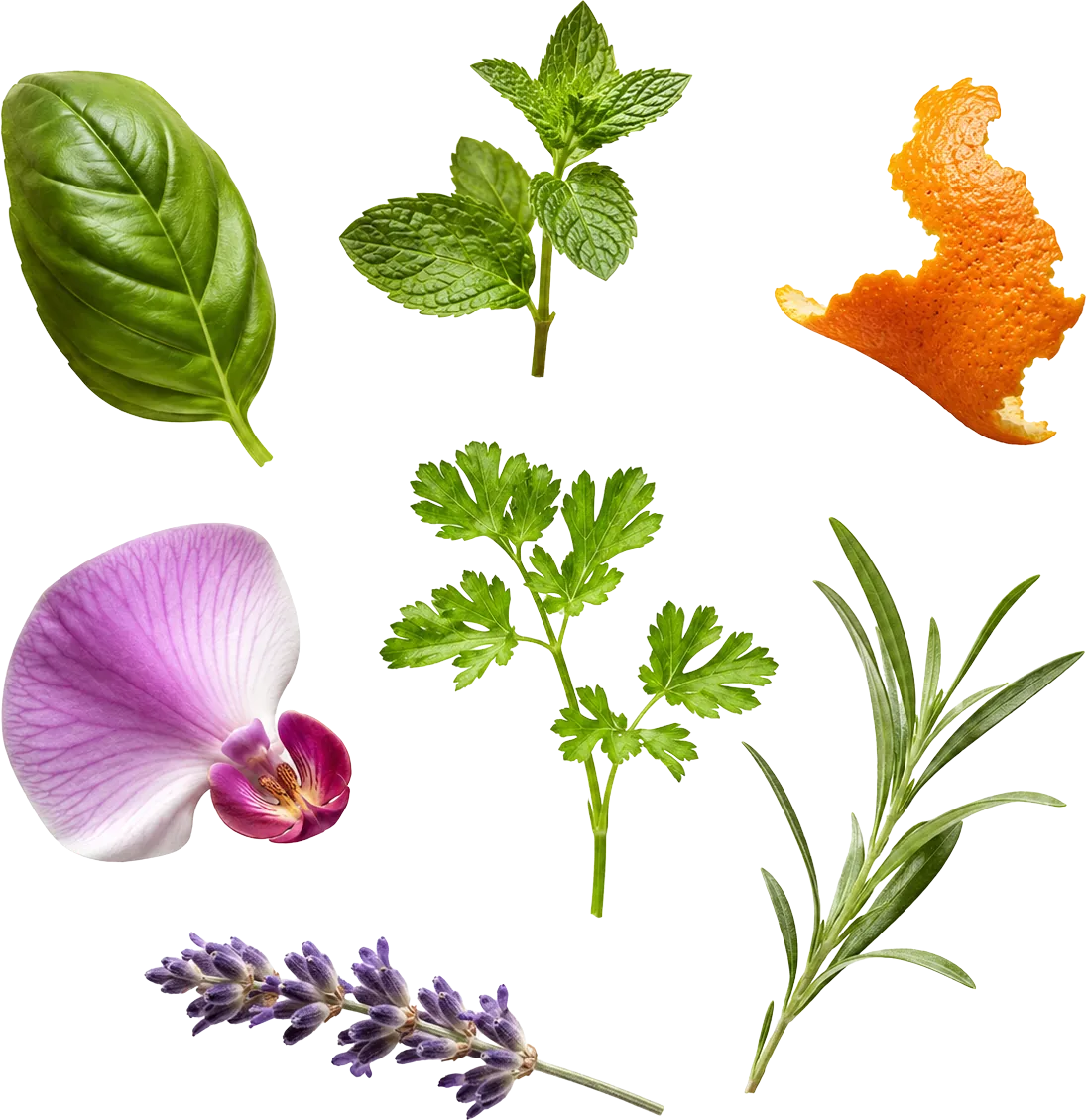
Where it appears in nature
established direct brain effects
Ocimene has no established direct effect on the human brain. Its ‘uplifting’ reputation is consumer lore, not a controlled finding. reference
Evidence ladder
Research is ranked by strength, not promised as effects. Isolated-compound findings are separated from whole-cannabis evidence throughout.
Ocimene is an acyclic C10 monoterpene (an open-chain triene) made from geranyl diphosphate; its cis and trans forms are established isomers.
Ocimene has no established direct effect on the central nervous system.
Uplifting or energizing descriptions are mainly consumer observations, not controlled findings.
Isolated ocimene has shown in-vitro antimicrobial, antifungal, anti-inflammatory, and insect-signaling activity.
Used in fragrance and floral flavor accords, and studied in plant-insect communication and botanical defense.
No established medical use exists for ocimene.
Myth vs evidence
Ocimene rides a bright, uplifting reputation in cannabis lore. The aroma is real; the direct energizing effect on the brain is not established.
Ocimene has no established direct CNS effect. The ‘uplifting’ or ‘energizing’ label is a consumer-reported association, not a controlled finding, and a panel value does not predict how a product will feel.
Where it sits
Objective chemistry and how often it shows up · not effects. Every authored terpene is plotted on each track; Ocimene is lit, the rest stay faint. The picture fills in as the Atlas grows (10 plotted so far).
Its strongest sensory class, brightest to deepest.
How often it leads a profile. Qualitative, not measured.
Lower boils off sooner, reading as an earlier top note.
C10 monoterpenes are lighter than the C15 sesquiterpenes.
| Terpene | Dominant aroma family | Prevalence in cannabis | Volatility · boiling point | Molecular weight |
|---|---|---|---|---|
| Myrcene | Earthy | very common | 167 °C | 136 g/mol |
| Limonene | Citrus | very common | 176 °C | 136 g/mol |
| Pinene | Pine | common | 155 °C | 136 g/mol |
| Linalool | Floral | common | 198 °C | 154 g/mol |
| Beta-Caryophyllene | Spice | very common | 262 °C | 204 g/mol |
| Alpha-Humulene | Herbal | moderate | 270 °C | 204 g/mol |
| Terpinolene | Fresh | moderate | 186 °C | 136 g/mol |
| Ocimene this page | Fruity | uncommon | 177 °C | 136 g/mol |
| Alpha-Bisabolol | Floral | uncommon | 314 °C | 222 g/mol |
| Nerolidol | Woody | uncommon | 276 °C | 222 g/mol |
Prevalence is a qualitative ordinal, not a measured concentration. Boiling points are approximate atmospheric-pressure values; the heavier sesquiterpenes are usually distilled under vacuum, so those figures are extrapolated.
Terpene neighborhood
On a certificate of analysis
A terpene’s absence from a panel can reflect the panel’s method or detection limit · not true absence. Values swing batch to batch.
In products
Sweet, tropical-leaning chemovars
Safety & handling
Pure terpene isolates are concentrated industrial chemicals · not the trace amounts in flower. Do not ingest undiluted isolates or apply them to skin without an appropriate dilution.
A product’s terpene panel cannot reliably predict an individual’s response or energy. Cannabinoid dose, route, tolerance, other medications, and personal biology usually matter more.
As a highly volatile monoterpene, ocimene is quickly lost and altered by heat, air, and storage; fresh and aged samples can differ sharply.
Explore
Same molecule, three lenses. The information is identical in every mode.
Keep exploring
Last reviewed 2026-07-22 · TerpAlerts editorial